 "Bang! Boom, ratata, boom, bang!" she said, while holding an imaginary rifle in her hand and doing her best to impersonate a testosterone driven male gamer, mouth agape and pupils dilated.
The person sitting across from me was my potential future boss, the creative director of a noteworthy agency in BC, interviewing me for a job. This was her reaction to me saying that video gaming was one of my hobbies. It was inspired by her general impression of video games (violence, explosions, guns, etc.), and followed by the question whether I was really into that.
My answer to her question was a protest. It started with a sigh and continued along the lines of "You shouldn't think that way," and "That's not really fair." But as I continued to explain my viewpoint, I was simultaneously realizing that her opinion, while unfair perhaps, was at the same time perfectly reasonable in its origination.
For what reason was there to think otherwise?
Even for those of us who know that there is so much more to video games than B-rated action movie rip-offs, it is no small mental challenge to dig up a glorious example of deep storytelling from our memories, without having to go many years back in time.
There was a time that video games were giving us thrilling glimpses of a new kind of storytelling, rich with emotion, philosophy, experimentation and unparalleled immersion. There was content on par with fine literature. Ironically, that was also the time when gaming was associated only with kids, teenagers, and adults who had horribly failed at getting a life. Gaming was far from being hailed by the incumbent media as a "cultural phenomenon." It was nowhere near being mainstream, and its appeal was deemed childish at best.
And then video games did what all the other media before them had done to gain mainstream popularity: they dumbed the content down. It was in the fashion of a brat screaming and begging for attention: loud, crass, inappropriate, irresponsible, hormone-driven. Gone were long chunks of dialogue from the screen, "because people did not like to read." Gone were thought provoking stories, "because people just wanted to have fun." The content did not mature up, but rather got an "M for mature," meaning it adopted a behaviour pattern rife with sex, violence, nudity and coarse language, just like a rebellious teenager imitating his/her impression of what an adult is. And it worked like a charm!
Today, video games are not simply a childish waste of time, produced entirely by isolated programmers here and there, doing some coding while they are slacking off on their full-time jobs. It is a big, serious industry, employing many professionals from a wide variety of digital fields, and serving a global market worth billions. The content strategy has served the industry well indeed. Or so it seems, if you ignore what is starting to happen now.
What got you here won't get you there
 It was back in April, Konami announced that they were dropping the controversial game Six Days in Fallujah even before it could see the daylight, due to an overwhelming outcry against the game's premise. The premise was a digital reenactment of one of the key battles of the Iraqi War, in the style of a First Person Shooter. It was criticised by both Pro-War and Anti-War commentators. Some blamed the game for trivializing war, while others said it was glorifying war. While these points might seem contradictory to a non-gamer, it should sadly be noted that war games (to date) have an uncanny knack for pulling off both offenses at the same time.
 Yet there is something in this story that does not make sense at first glance. After all, this was not the first attempt to portray the Iraqi war. There are already many movies made about almost any war in recent and far history - most of them featuring Americans fighting in somebody else's country. Why such a strong reaction to a game when seemingly anyone can make a movie about anything related to war?
Add to this puzzle the fact that there are games such as Modern Warfare, Battlefield series, and many more, taking place within the context of imaginary conflicts that are blatantly obvious anagrams of real world conflicts, and yet faring merrily in sales figures with nary a protest, nor an objection. So what's going on here?
The answer is simple. When it comes to handling sensitive subjects of the real world with due care, video games just have zero - none, null, nada, squat - vote of confidence from their audience. The situation is exactly that of the previously described rebellious teenager who, upon asking if he/she could take the keys to the family car to go to a late night party, is given the answer: "Yeah, right. Like that's gonna happen in a million years."
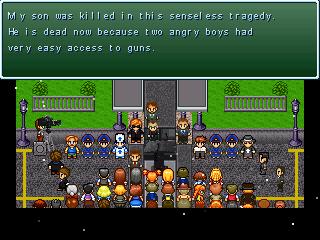 Six Days in Fallujah is not the only manifestation of this. It is a similar thing that happened to the game Super Columbine Massacre RPG at the Slamdance festival of 2006. A different kind of reaction stemming from the same sentiments came for the last Resident Evil game, blaming the developers for being insensitive about racism.
Movies do not suffer from the same bias because that medium has long proven itself capable of "adult responsibility" with many fine examples of film making. They have deserved and earned the benefit of doubt that saves them from being cancelled even before being filmed.
While the braindead marketing philosophy of the last century might think of these controversies as "great publicity for games," (Dante's Inferno, you hear this?) the truth is that there is no more ground left to be won by such tactics. In fact these very tactics are becoming a hindrance for video games in their rise to the dominant medium of the future throne. Especially at a time when the whole global business community is engulfed in change towards more social responsibility, this particular industry runs the risk of drawing more and more ire from gamers and non-gamers alike, for its glaring indifference and reluctance to grow up.
It is now time that the teenager should get a clean haircut, learn to self-administer mouthwash, and start wearing something that doesn't have skulls and pentagrams on it. Such a thing is far from being unimaginable. It used to be, in fact, a reality.
The humour in the Secret of the Monkey Island was comparable to Terry Pratchett. The haunting riddle of Planescape: Torment was no less profound than any quote from Nietzche. The noir style of Grim Fandango could make Tim Burton jealous. The video games industry used to be that responsible person (and still immensely fun) a long time ago. And it can become that person again.
But how, you ask, will video games prove themselves worthy if they are not even given a chance? My answer is: learn to mow the lawn first before you ask for the car keys. Work your way up from less sensitive subjects and show the world you are ready to take the responsibility of being the dominant medium.
As a good example to that, I recommend looking at how Battlestar Galactica series handled the topic of terrorism, war, and even suicide bombings admirably, without offending its audience. There are lots of similar examples out there, if one wants to find them.
(Note to journalists and researchers: Next time, before you publish an article about storytelling in video games, please do take time to study the matter in depth. When you ignore all those fine examples of storytelling as if video games started off with Grand Theft Auto, you end up misleading your audience and hurting the credibility of your authority in the subject field.)
(Note to my interviewer: No offense meant to you at all! It's still okay to hire me!)
P.S. I have copied the comments from game-devs about my article in a new post, which you can find here. Or you can join the Game Developers group on LinkedIn to see them there.
Read more!


 Posts
Posts


