Read more!
Tuesday, September 29, 2009
How to Create/Market Games for Women
Read more!
Sunday, September 6, 2009
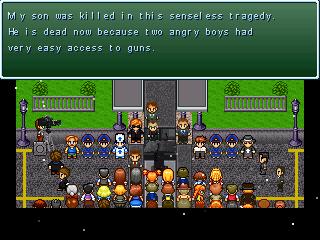
Why "Six Days in Fallujah" was really cancelled
The person sitting across from me was my potential future boss, the creative director of a noteworthy agency in BC, interviewing me for a job. This was her reaction to me saying that video gaming was one of my hobbies. It was inspired by her general impression of video games (violence, explosions, guns, etc.), and followed by the question whether I was really into that.
My answer to her question was a protest. It started with a sigh and continued along the lines of "You shouldn't think that way," and "That's not really fair." But as I continued to explain my viewpoint, I was simultaneously realizing that her opinion, while unfair perhaps, was at the same time perfectly reasonable in its origination.
For what reason was there to think otherwise?
Even for those of us who know that there is so much more to video games than B-rated action movie rip-offs, it is no small mental challenge to dig up a glorious example of deep storytelling from our memories, without having to go many years back in time.
There was a time that video games were giving us thrilling glimpses of a new kind of storytelling, rich with emotion, philosophy, experimentation and unparalleled immersion. There was content on par with fine literature. Ironically, that was also the time when gaming was associated only with kids, teenagers, and adults who had horribly failed at getting a life. Gaming was far from being hailed by the incumbent media as a "cultural phenomenon." It was nowhere near being mainstream, and its appeal was deemed childish at best.
And then video games did what all the other media before them had done to gain mainstream popularity: they dumbed the content down. It was in the fashion of a brat screaming and begging for attention: loud, crass, inappropriate, irresponsible, hormone-driven. Gone were long chunks of dialogue from the screen, "because people did not like to read." Gone were thought provoking stories, "because people just wanted to have fun." The content did not mature up, but rather got an "M for mature," meaning it adopted a behaviour pattern rife with sex, violence, nudity and coarse language, just like a rebellious teenager imitating his/her impression of what an adult is. And it worked like a charm!
Today, video games are not simply a childish waste of time, produced entirely by isolated programmers here and there, doing some coding while they are slacking off on their full-time jobs. It is a big, serious industry, employing many professionals from a wide variety of digital fields, and serving a global market worth billions. The content strategy has served the industry well indeed. Or so it seems, if you ignore what is starting to happen now.
What got you here won't get you there
Yet there is something in this story that does not make sense at first glance. After all, this was not the first attempt to portray the Iraqi war. There are already many movies made about almost any war in recent and far history - most of them featuring Americans fighting in somebody else's country. Why such a strong reaction to a game when seemingly anyone can make a movie about anything related to war?
Add to this puzzle the fact that there are games such as Modern Warfare, Battlefield series, and many more, taking place within the context of imaginary conflicts that are blatantly obvious anagrams of real world conflicts, and yet faring merrily in sales figures with nary a protest, nor an objection. So what's going on here?
The answer is simple. When it comes to handling sensitive subjects of the real world with due care, video games just have zero - none, null, nada, squat - vote of confidence from their audience. The situation is exactly that of the previously described rebellious teenager who, upon asking if he/she could take the keys to the family car to go to a late night party, is given the answer: "Yeah, right. Like that's gonna happen in a million years."
Movies do not suffer from the same bias because that medium has long proven itself capable of "adult responsibility" with many fine examples of film making. They have deserved and earned the benefit of doubt that saves them from being cancelled even before being filmed.
While the braindead marketing philosophy of the last century might think of these controversies as "great publicity for games," (Dante's Inferno, you hear this?) the truth is that there is no more ground left to be won by such tactics. In fact these very tactics are becoming a hindrance for video games in their rise to the dominant medium of the future throne. Especially at a time when the whole global business community is engulfed in change towards more social responsibility, this particular industry runs the risk of drawing more and more ire from gamers and non-gamers alike, for its glaring indifference and reluctance to grow up.
It is now time that the teenager should get a clean haircut, learn to self-administer mouthwash, and start wearing something that doesn't have skulls and pentagrams on it. Such a thing is far from being unimaginable. It used to be, in fact, a reality.
The humour in the Secret of the Monkey Island was comparable to Terry Pratchett. The haunting riddle of Planescape: Torment was no less profound than any quote from Nietzche. The noir style of Grim Fandango could make Tim Burton jealous. The video games industry used to be that responsible person (and still immensely fun) a long time ago. And it can become that person again.
But how, you ask, will video games prove themselves worthy if they are not even given a chance? My answer is: learn to mow the lawn first before you ask for the car keys. Work your way up from less sensitive subjects and show the world you are ready to take the responsibility of being the dominant medium.
As a good example to that, I recommend looking at how Battlestar Galactica series handled the topic of terrorism, war, and even suicide bombings admirably, without offending its audience. There are lots of similar examples out there, if one wants to find them.
(Note to journalists and researchers: Next time, before you publish an article about storytelling in video games, please do take time to study the matter in depth. When you ignore all those fine examples of storytelling as if video games started off with Grand Theft Auto, you end up misleading your audience and hurting the credibility of your authority in the subject field.)
(Note to my interviewer: No offense meant to you at all! It's still okay to hire me!)
P.S. I have copied the comments from game-devs about my article in a new post, which you can find here. Or you can join the Game Developers group on LinkedIn to see them there.
Read more!
Thursday, July 23, 2009
What to learn from Battlefield 1943
It is very rare that I applaud EA on this blog for anything, but this time they've done good. I've told numerous times in my writings that a game does not need to follow the "all bells and whistles for $60+" approach in order to be commercially successful. Kudos to DICE for figuring out all the value added components of their game that matter to their customers, and stripping everything else away, including retail units. The result is a no-frills game for $15, which happens to sell faster than hot cakes.
Strangely, being sold on Live Arcade at that price point makes it a quite frill-full game. Instead of a lackluster game trying to compete with the likes of Call of Duty (much like BF: Bad Company tried to do at the regular price point), being a great game for the $15 price point is a much better differentiation strategy.
The question is, though; can it be repeated? It is important to understand that such low price might not have been possible if the developers had to design the maps from scratch, or if they had to develop the Frostbite engine for the first time, or if they didn't have a pretty familiar set of game mechanics refined many times in the previous iterations of their franchise. Speaking of the franchise, it is also worth considering what the outcome would be if they did not have the Battlefield brand behind the game. Would it still perform well? Would the brand name of DICE be enough?
All in all, I am pleased to see EA trying different approaches for a game's value offering, and I'm hoping their success with this title will encourage them to experiment more and perhaps answer some of the questions above in doing so.
Read more!
Monday, June 8, 2009
Ethics in viral marketing
Seth Godin defines viral marketing as "... an idea that spreads--and an idea that while it is spreading actually helps market your business or cause."
When you employ a bunch of fake religious protesters to create buzz for your game, like EA had done to promote Dante's Inferno, the only idea you are spreading is that you are not above fabricating a false reality and presenting it as the real deal in order to get attention, very much like a spoilt, immature brat would. It says very little about your game, offers no real value to the gamer, and speaks volumes about what you think of marketing ethics and how much you (don't) respect your customers.
Should also note: admitting that you have pulled a publicity stunt, days after the fact, does not make it all fine and acceptable. Admitting to a lie without any apology only tells us that we probably should expect this behaviour from you again in the future.
If you are reading these lines, I hope you will mark this post as an example on How Not To Do Viral Marketing / How Not To Create Buzz.
Read more!
Thursday, March 19, 2009
Designer branding in video games (branding alternatives - part 1 of 3)
- Designer branding
- Developer studio branding
- Publisher branding
1. Designer Branding
One could say The Sims franchise relied on the brand equity of the past "Sim-" line of games such as SimCity, SimLife, SimEarth and so on. Or you could say it was the developer Maxis that connected all the dots in its brand essence. My guess is you would not really say that, for you probably know as well as I do, their latest title "Spore" relied neither on Maxis nor any apparent Sim-anything in its name, as much as it did on the brand name of Will Wright himself as its designer.
He is not the only game designer to have a notable brand value of his own. Sid Meier is another easily recognizable name, associated with Civilization, Colonization and Pirates! games among others. That association is a deliberate marketing strategy, as in some cases he was not even the actual main designer of the games branded with his name. Peter Molyneux is another well-known designer of that generation. Jenova Chen is a more recent brand, building up with titles such as Flow and Flower.
The question to ask is:
"What is it about these people that can turn their names into real brands?"
The answer is heart-warming (at least for me): They are all known for having taken creative risks with positive end-results.
The first three names I mentioned are all old-timers, people who have been in the industry since its fledgling, entrepreneurial times. The last one also shares the same spirit as an independent developer, but has emerged only recently. Maybe it is my own ignorance but my mind draws a blank at large when I try to think of a brand-worthy designer that emerged between those old times and the rise of indie games. This comes as no surprise because that slice of time is known to us gamers as a period of brain-numbing unoriginality.
What this tells us is: by trading off creative freedom for risk mitigation, the video games industry has deprived itself of a powerful branding option. In rare cases where originality does shine through, such as in Portal, we see a missed opportunity in this regard where the designer's name is absent or not associated strongly enough with the IP.
One possible reason for that could be the failure versus success rate in the industry. The names Daikatana and Romero are probably the most memorable ones to remind us creative risk can also bring failure in epic proportions. Yet I still believe there are ways around such a risk. Post-mortem branding is an obvious one. Wait to see how well the game fares. If it does well, go ahead and make a star of its designer. Or put their name on the Gold Edition box.
Another option can be cultivating designer name brands one risk level at a time. In the current market where there is much buzz around indie games, it is no longer difficult to reach fame with a small budget title. Could it be a viable business strategy for a publisher to reward successful designers with gradually increasing budgets and brand names of their own? An incubator for the future rockstars of the industry perhaps?
Read more!
Monday, January 12, 2009
I didn't like Fallout 3 either
The reason is simple and somewhat laughable: I was afraid of what it could mean if I admitted not liking it. Could it mean I was getting old? Had I lost my appreciation for the medium? Had my inner child died? The answer, I realize, is none of those. It is something far worse perhaps: the gaming that I used to like seems to be dying, if not dead already.
For me, my fascination with games was always for discovering something new. When I was a little kid, I did not have internet access to read reviews from. I could not even find any gaming magazines to read in my country. So it was a treasure hunt each time I went to the computer store, and read the long (and sometimes handwritten) list of games, picking titles I had heard about but not knowing what I would get. And yes, they were pirated copies. But simply because no company was shipping to my corner of the world in those days. I used to play games with no tutorials, no manuals, spending hours and hours trying to understand how it all worked.
It was the talk of the whole school when some kid managed to make the jet fighter take off in some simulation game. Knowing the way to tackle a tough puzzle in the Secret of the Monkey Island was a golden bargaining chip in many situations that a schoolboy might have to settle with his peers. Being one level ahead than the next kid on Dune 2 meant being on a whole different level of existence, as you had access to wonders that they did not. Back in the day, gameplay duration given in hours used to give you an idea about the amount of treasure buried in a given game, the amount of things to discover. These days it simply means how much of a drone-like activity you will repeatedly perform until you reach a sorry excuse for a story ending.
The games I loved used to stand for originality. They used to give me an incredibly valuable resource for my mind: a venue for discovery. It saddens me greatly to realize that this huge benefit has been taken away from me. It saddens me to know that when I look at the DVD cases at the retail store, I know exactly what makes them tick without opening the case, let alone playing them. They all follow the same 'tried and true' formulas of RTS, RPG, FPS, whathaveyou. They were all designed with the common sense of 'not fixing what did not break.' Sometimes I know it all just by hearing the name of the title. I know all too well how it will play out, what resources I will gather, what mechanics I will utilize, what 'world changing choices' I will have to make, and all that good stuff. -- (I also have to note; it is becoming something of an industry norm that whenever someone speaks of world changing choices in a RPG game, it turns out they were referring to a very singular and isolated instance in the whole game, outside of which everything is scripted and streamlined like an elementary school play)
I was hoping it would be different, that it would be like the good old days with Fallout 3. After reaching level 8, though, I no longer see a point in going any further. There is nothing left to discover. All the areas unlocked thereafter, all the dungeons I have missed, I am pretty sure I have already seen them in other games if not in Fallout 3 itself.
This is why people (including myself) are playing more and more casual games. Because we find something in those games that I cannot find in Fallout 3. When a browser game loads, I find joy in the fact that I have no idea how it will play out. Sure, it takes me less than five minutes to figure it all out, but guess what, then I can move on to another without having to pay $59.99 again. In that sense, it is ironic that what people call casual gamers might very well be the true hardcore gamers, for what they derive from the experience is what the medium used to stand for.
I sometimes think whether the video games industry is just waiting for that group to die out, so the marketing divisions will have no trouble selling their games to impressionable youngsters of the future who will have nothing better to compare to. It is a bitter thought along with the predictions in the news saying games will be the dominant media of the future. There was a time I would be very excited about that statement. These days I don't even know if we are talking about the same thing when they say 'games.'
Read more!
Tuesday, September 16, 2008
To boldly go noone knows where
As I said previously, my goal in this blog is to combine a business perspective with a passion for games. Truth is, though, a year ago from now I only had the latter and not so much of the former. This is why an article by William Vitka, dated 2005, was still news to me when I first read it this year. The title read “In-Game Advertising” and was discussing the trends in this new and exciting marketing frontier. Sitting in class and reading this article three years after its publishing, I thought I must have missed a lot in the meantime.
The perpetually new frontier
Or have I?
Here is a quote from an article by Phil Elliott (Advertiser’s Context, 2008):
“In-game advertising is set to be one of the hottest subjects of 2008 and while most people seem to agree that there's a lot of potential new money to be made for videogames publishers, quite how that will be realised is still debated.”
This debate stems from another important question; what is the most effective way of employing in-game advertising? Much of the research undertaken in this field in the last three years comes from the agencies themselves, and therefore gives cause to skepticism about the true potential of the medium.
Another reason, Elliott proposes, is that the video games industry is moving at an intimidating speed for advertisers, changing at much higher rates than traditional channels such as TV and radio. Even though this makes sense when you compare games to television, the explanation is somewhat less convincing when you hold comparison to a more similar medium. The internet is not so slow moving at all, yet it is already thoroughly infested by all kinds of advertisers.
What is the difference then?
There are opposing forces at play here. On one side companies are trying to avoid the first mover disadvantage by watching the others first and learning from their mistakes before launching their own in-game campaigns. On the other side, there is the pressure of the possibility that your competitor might just get it right before you do. When Nike reaches out to the masses of 18-34 year olds through in-game advertising, how long can Adidas afford to leave them completely unchallenged and unchecked? Or think Coke and Pepsi. Not so surprisingly, the answer is ‘not very long.’ An article on Gamasutra.com ( back in 2006) proves the point perfectly. Traditional brand rivalries are strong propulsion for in-game advertising.
There is no huge difference between general internet advertising and in-game advertising in this regard. The latter is simply at the beginning of its life cycle and is on a very healthy growth rate to maturity in the future. Innovators and early adopters of the medium will eventually provide the critical mass of good and bad examples necessary to make the leap to wide adoption.

The one big difference lies in the structures of the two media. The internet has a great multitude of channels to reach the consumer with advertisements. The conditions are close to perfect competition and the dynamism allows for quick experimentation. This is not so much the case in the video games industry dominated by two big publishers such as EA and Activision, where the number of PC and console titles at one time is limited. Add to that the long (and sometimes unpredictable) development cycles of blockbusters, as well as the complexity of advertiser-agency-publisher-developer relations in developing of advertisement capabilities. Looking from that perspective, advertising in big PC and console titles may be more similar to ads in movies.
In-game advertising is not limited to the cutting edge of hi-tech gaming, however. Research from eMarketer shows ad spending in web based games has a growth rate of nearly 40%, compared to 30% in PC and consoles, between the years 2007 and 2008. This is more in line with the “Do It Wrong Quickly” philosophy of internet marketing, for the flexibility the web provides.
The suggested offset to this lack of flexibility in big titles is the use of dynamic ads, placed on billboards or other in-game surfaces, which can be changed in real-time. In theory this sounds pretty sweet. In practice, however, what you can change in real-time is the content of your advertisement. The context (the game in which it appears and the method of interaction) remains largely the same. Compared to web advertising where you have greater control over both content and context, there is still a considerable disadvantage.
Frag or Coke?
The original article from Vitka does not mention the issue of metrics, but a good deal of the debate boils down to that point. Again, Elliott explains the situation:
“…the three big sellers of aggregated in-game ad space don't even have the same measure for what constitutes an 'impression' (the oft-used number on which the advertiser gets billed).”
The problem with in-game billboard ads is that it is almost impossible to identify and formulate the instances where the interaction with the user is meaningful and the message is properly delivered. While the ad may show up on your screen when you are playing a game, your attention could be highly focused on anything (such as the enemies trying to kill you) but the ad at that specific time. A good study on the issue is the report on advertising effectiveness in ‘Battlefield
Only it's not always a pleasant walk in the battlefield
This argument then leads to the two big components of in-game advertising: gamers and developers. The sentiment has pretty much been the same in the two articles with three years between them; if the consumer will not be getting anything out of this deal, then nobody will. The acceptance of advertising in games depends largely on winning over the gamer and operating in a way that will not disturb their entertainment experience. This is very critical considering how outspoken the gaming community can be. An aggressive strategy could cost both the publisher and the advertiser dearly.
I would suggest that the best way to explore new techniques and ways of non-intrusive in-game advertising lies in collaboration with developers. In that respect, the exact size of the cut that the devs will get out of this trend probably depends largely on how much of this opportunity they can realize and incorporate into their business models.
Read more!
Wednesday, September 3, 2008
Selling? Game? What?
My main goal here is bringing together two big interests of mine: computer games and marketing. Oddly enough, I am an expert neither in one nor the other. Why then?
Why computer games?
Because they are fun and exciting. In the way that movies were exciting when cinema emerged. In the way that radio was exciting in the early days of wireless broadcasting. One might go on with this list, adding things like the classical theatre or even the advent of writing.
Simply put, video games are a new and revolutionary medium for artistic expression and storytelling, if not the most advanced one at our disposal. The potential for immersion, expression and interaction is almost limitless. Yet if so, why are we not already seeing content that rivals classical literary works? Why is it not dubbed the 8th Art (the number is negotiable) yet? How come one of the biggest companies in the industry owes its success to publishing the same sports games over and over again every year? How did we lose the values of originality and creativity, and ended up with 'tried and beaten to death formulas' like RTS, FPS, and whathaveyou?
Why marketing?
Because things are not as limitless as they seem. A video game is a commercial product like any other. It needs people to use it, play it. It has to meet a need, and it has to find the right person with the right need. Otherwise? It is meaningless. It does not sell and it does not get played. It gives its developers little reason and provides even less means to achieve consistency in creation of great new works.
Thus the future of the medium is largely determined by what is commercially successful. This is why we have been playing the endless iterations of the same soccer title for the last decade. Because it has found its niche, and its commercial fortunes are, more or less, predictable and safe for the business-mind.
On the other side of the spectrum we see games, developed with amazing talent and production value, which somehow fail to achieve a commercial success. The game 'Planescape: Torment' is probably the best example to this. Sadly, each consecutive failure of originality (aided by each consecutive commercial success of the tried and beaten-to-death) delays the medium from achieving its true potential.
So?
So it is my vision and goal to find the grounds where profitability and quality (with originality and creativity being its primary metrics) do not have to be competing goals. As a MBA candidate and gamer who is trying to get into the industry, my goal in this blog is to explore the dynamics between the content and business sides of the medium. Hopefully my writings will help me (and possibly others) in framing, analyzing and solving this challenge.
In short:
The Selling Game - How to sell games that deserve to be played.
Read more!